
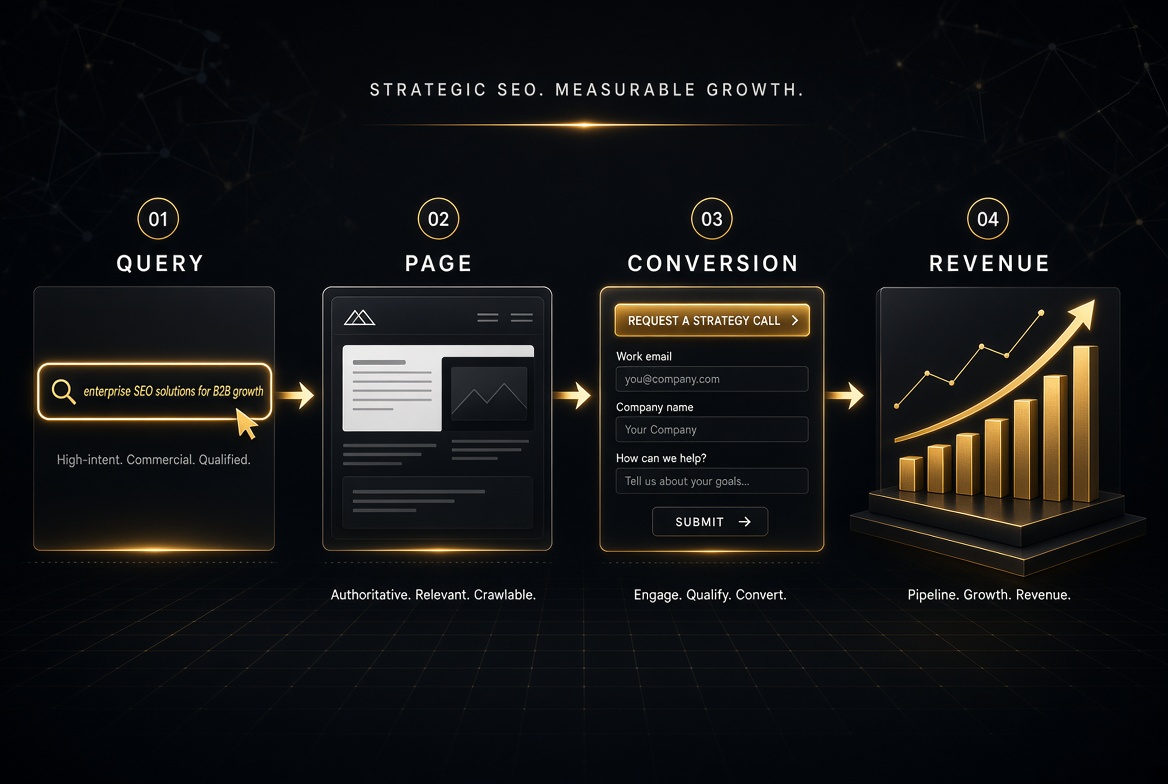
Most businesses don’t have a traffic problem. They have a demand-capture problem.
That’s the line that survives a CFO meeting. Not “we published 12 blogs.” Not “domain authority went up.” Not “we’re on page two for a pile of keywords nobody buys from.” The only SEO model that holds under commercial scrutiny is simple and ruthless:
Query → Page → Conversion → Revenue.
It’s the backbone of the IOS Method. Everything else is activity. This is architecture.
Activity SEO fails commercial scrutiny
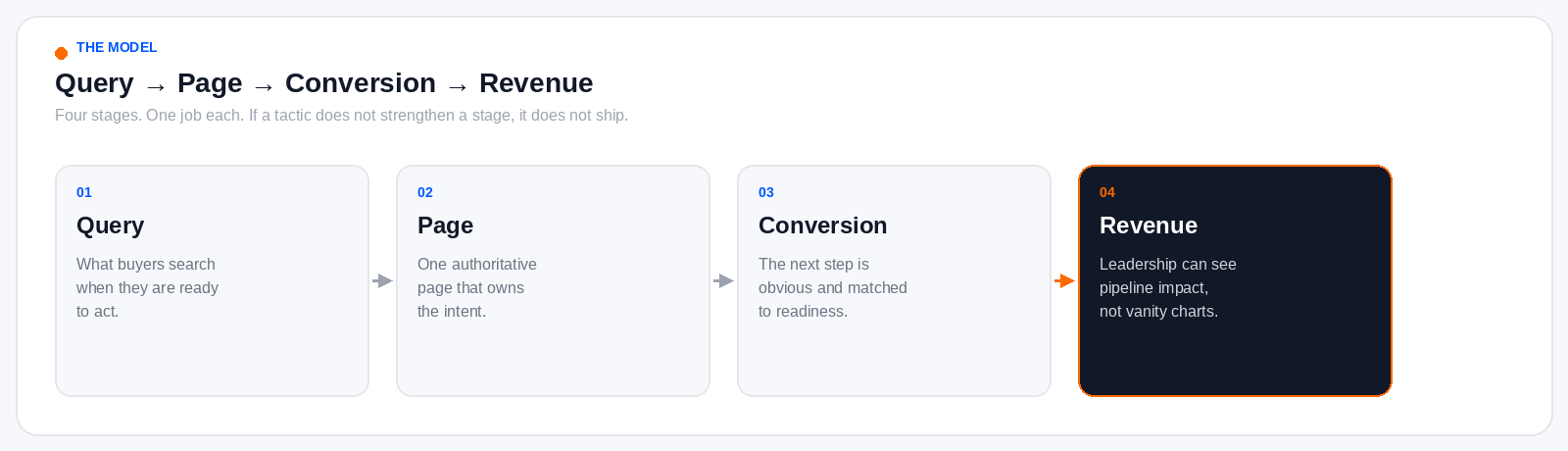
Traditional SEO sells motion. Keyword lists. Content calendars. Link outreach. Ranking screenshots. Monthly “wins” that never show up in pipeline reviews.
None of that is automatically wrong. Tools, content, and technical work all matter. The failure is treating them as the product. Activity SEO optimizes for deliverables a vendor can ship on a retainer calendar. Revenue architecture optimizes for a chain leadership can defend when budgets get questioned.
Activity SEO collapses the moment someone asks a commercial question:
- Which searches create revenue opportunities?
- Which pages own those intents?
- What happens after the click?
- Can we see impact in leads, calls, or closed revenue?
If your SEO partner answers with traffic charts and “brand awareness,” you’re funding a content mill with a reporting costume. Leadership doesn’t buy activity. They buy demand capture — the ability to intercept high-intent demand, land it on the right page, convert it, and prove the money trail.
That’s why so many SEO programs feel busy and fragile at the same time. They’re optimized for output volume, not for the path that turns a search into a sale. The team is full. The dashboards are colorful. The pipeline still leaks.
The only model: Query → Page → Conversion → Revenue
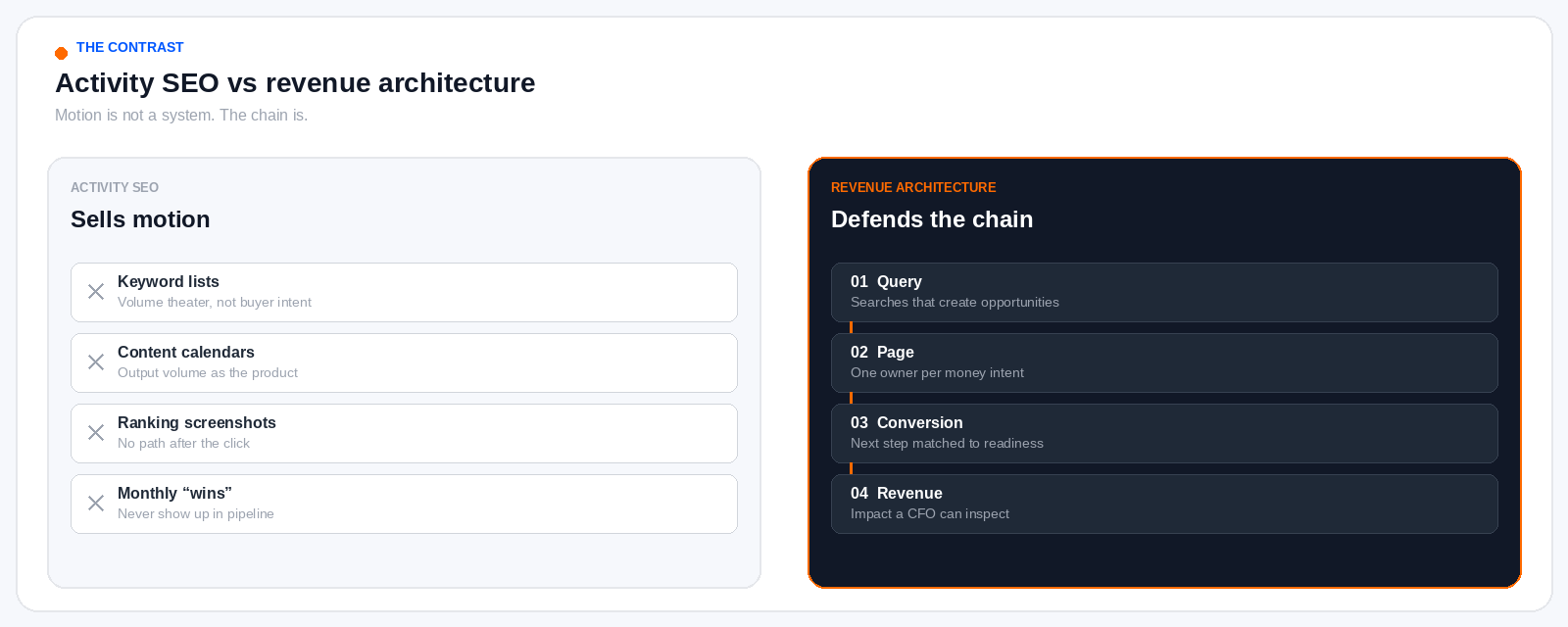
Four stages. One job each. If a tactic doesn’t strengthen a stage, it doesn’t ship. That rule is what keeps SEO from drifting into vanity work.
1. Query — what buyers search when ready to act
Start with commercial intent, not keyword volume theater. Search volume is a clue, not a strategy. The useful questions are sharp:
- What do buyers type when they’re comparing vendors?
- What do they search when something broke and they need a fix now?
- Which queries imply budget, urgency, location, or a buying committee?
- Which adjacent research queries feed the money queries later?
Kill ranking for noise that never converts. A query earns priority when it maps to revenue potential — not when a tool paints it green. In a CFO meeting, “we rank for 400 keywords” is trivia. “We capture the searches that create opportunities” is a strategy.
2. Page — one authoritative page that owns the intent
Every priority query needs a page with a job. Not a thin blog that vaguely “covers the topic.” Not five near-duplicates fighting each other in search results and confusing the buyer after the click. One clear owner:
- Matches the intent (informational vs commercial vs transactional)
- Carries enough depth, clarity, and proof to win the SERP job
- Is internally linked and structured so authority compounds into it
- Doesn’t get cannibalized by weaker siblings
If you can’t name the page that should win a money query, you don’t have a content problem — you have an architecture gap. Publishing more posts into that gap usually makes it worse.
3. Conversion — the next step is obvious and matched to readiness
Traffic without a path is leakage. Conversion here isn’t “add more CTAs.” It’s matching the next step to where the searcher actually is:
- Ready-to-buy → audit request, quote, call, demo, booking
- Evaluating → proof, comparison, method, risk reduction
- Researching → clarity that builds trust without forcing a hard sell too early
A page can rank and still fail. If a high-intent visitor lands, reads, and has no useful next step — or the wrong next step — SEO didn’t fail at rankings. It failed at demand capture. That’s why conversion belongs in the SEO model, not in a separate “CRO later” parking lot.
4. Revenue — leadership can see pipeline impact
The last stage is the one activity SEO avoids. Reporting has to answer commercial questions:
- Are priority queries landing on the right pages?
- Are those pages converting better over time?
- Are leads, calls, opportunities, or revenue proxies moving?
- Where is the next highest-leverage fix in the chain?
Vanity dashboards die here. Perfect impressions with no commercial story don’t survive budget season. Revenue architecture survives because it ties organic work to outcomes a CFO already understands: demand in, opportunity out, leakage found, priority next.
Failure modes this model kills
Run every SEO idea through the chain. Watch the usual failures lose their cover story.
Blog volume without intent owners
Publishing more doesn’t capture demand if nothing owns the money queries. Volume without page ownership is inventory, not strategy. The model forces a harder question before the brief is written: which query does this page help us win, and what does winning convert into?
Rankings that don’t convert
“We’re ranking” is incomplete. Ranking for non-buying intent, or ranking onto a page with no path, is a report line — not a growth system. The model makes conversion and revenue first-class, so ranking alone can’t pretend to be success.
Technical SEO as a standalone sport
Crawl health matters. Indexation matters. Speed matters. None of it matters commercially if it isn’t clearing the path for priority queries to reach converting pages. Fix the blockers that protect the chain. Don’t burn quarters polishing pages that don’t sit on the money path.
Authority work detached from money pages
Links, mentions, and digital PR should strengthen the pages that own commercial intent — not inflate a homepage vanity score while money pages stay thin, conflicting, or unlinked. Authority is a means. The page that captures demand is the point.
Reporting that can’t survive finance
If the monthly deck can’t explain pipeline movement — or at least a trusted proxy — it’s theater. The model forces the conversation back to Query → Page → Conversion → Revenue every time. That’s uncomfortable for vendors who sell activity. It’s clarifying for operators who own outcomes.
How this shows up in an IOS engagement
Inbound Organic Systems doesn’t sell “SEO tasks.” We install a demand-capture system. The engagement shape is in the Method; the operating product is Organic SEO Systems.
In practice, the model shows up like this:
- Authority Audit — map high-intent queries, page coverage, conversion paths, and leakage. Diagnosis before deliverables theater.
- Blueprint — a 90-day roadmap prioritized by revenue potential, dependency, and urgency. What to do first, what can wait, what shouldn’t be done at all.
- Install or advise — same framework, two modes: hands-on system installation, or advisory direction for teams that already execute.
- Measure and compound — report against the chain, then reinvest in the next highest-leverage link.
That’s the difference between activity SEO and revenue architecture. One fills calendars. The other strengthens the path from search demand to commercial outcomes. We don’t need a novel framework every quarter. We need the same chain, applied with discipline, until leakage stops being normal.
If you can’t defend the chain, you don’t have a strategy
Keep the test simple. For any SEO initiative — a content brief, a technical sprint, a link campaign, a redesign — ask:
- Which query does this help us win?
- Which page owns it?
- What conversion does that page earn?
- How does that show up in revenue (or a hard proxy leadership trusts)?
If those answers are fuzzy, you’re back in activity mode. Bring the work back to the chain — or don’t fund it. That standard is what makes Query → Page → Conversion → Revenue the only SEO model that survives a CFO meeting.
Want the model applied to your site instead of another ranking report? Start with diagnosis. The Organic Authority Audit maps intent, pages, conversion paths, and revenue priorities — then turns leakage into a 90-day plan. Request an Organic Authority Audit. Or review the full engagement flow on the IOS Method page.